

Static Reporting is Reaching Its Limits
For years, reporting has been the foundation of physical security programs. Incident reports, touring reports and daily activity reports have provided structure and visibility into operations. Over time, that reporting has expanded to include KPI tracking, budget reports, performance dashboards and real-time operational views.
Teams are also working across site activity, location details, staffing coverage, assignments and broader operational processes, often moving between multiple systems or views to understand what is happening. Individually, each of these tools serves a purpose. Together, they create a much more complex picture.
That leads to a simple question. How easy is it, really, to get a clear answer when you need one?
This is where conversational intelligence is beginning to change expectations.
Despite having more data than ever before, many organizations are finding it harder to turn that data into timely decisions.
The Problem Isn’t Data. It’s Access to Answers.
Most organizations already have the information they need. They can pull incident activity, monitor patrol and coverage data, analyze performance metrics, track budgets and reference dashboards that provide a high-level view of operations. The data exists and, in many cases, it is comprehensive.
But having access to data is not the same as having access to answers. When a question comes up, the process often looks the same. You open a report, filter by location, compare timeframes and then cross-reference another system or report. Even after doing all of that, the answer is not always obvious.
Leaders are not asking for more data. They are trying to understand what is happening, why it is happening and what they should do next.
What they need is clarity.
Clarity, cut through multiple reports, connects information across systems and makes it immediately clear where attention is needed. Without that clarity, even the most comprehensive data becomes difficult to use and impacts decision-making.
Conversational intelligence has the potential to provide that clarity, but only if it is applied in the right way.
That is where the gap becomes clear.
NOT SURE WHERE YOUR PROGRAM STAND TODAY?
Take the AI Maturity Assessment to see how your organization compares and where opportunities exist to improve speed, visibility and decision-making.
Why Static Reporting Creates Friction
Think about what it takes to answer a single question.
For example, you might ask: Why are incidents increasing at this location?
You might start with a dashboard to identify a trend, then move into incident reports to understand what occurred. From there, you check touring or coverage data to see if there were gaps in service and review site activity or staffing assignments to understand what security presence was in place at that time.
Each step provides a part of the story, but none of them provide the full picture on their own. Even with tools like live operational views showing which locations currently have security presence or ongoing site activity, you still have to interpret what that means in the context of everything else.
So the real question becomes how long it takes to get from question to understanding and how often that delay impacts your ability to act.
This is exactly the type of problem conversational intelligence is designed to solve.
A Shift in Expectations: From Reports to Answers
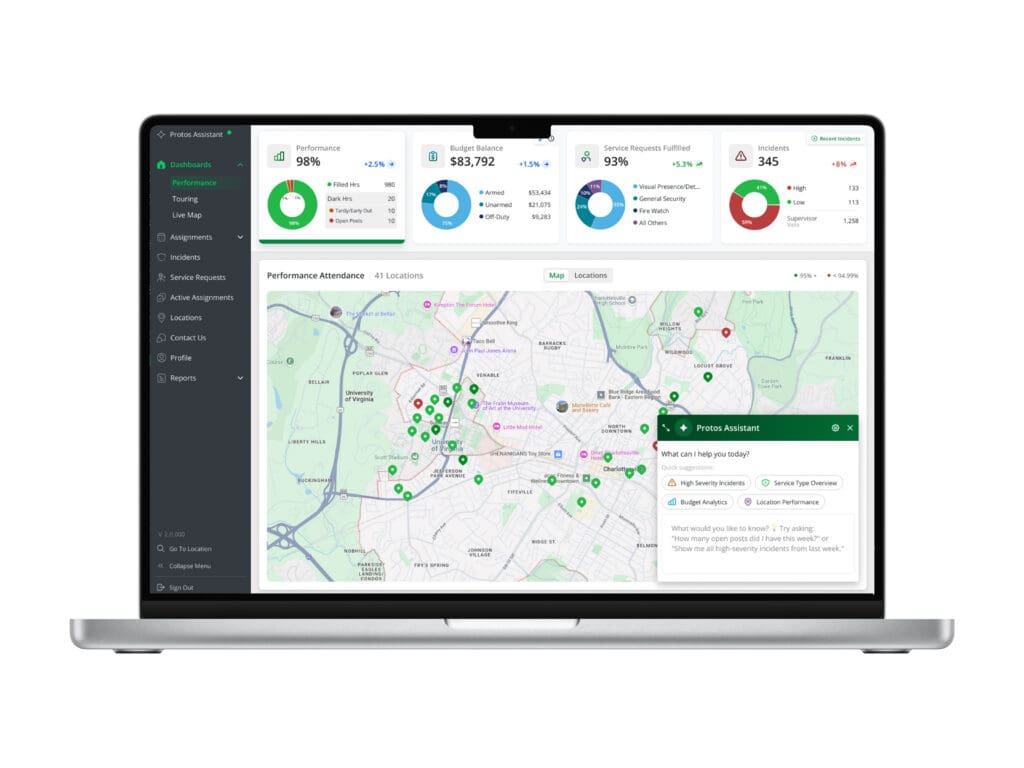
The way people expect to interact with information has changed. Users no longer want to spend time digging through multiple reports to find an answer. The expectation today is much simpler. When a question comes up, the answer should be immediate and easy to understand.
This shift is already happening across other areas of business and technology. Instead of navigating systems, users are asking questions. Instead of filtering dashboards, they are getting direct responses.
Advancements in AI have made conversational intelligence possible at scale, accelerating this shift.
What began in customer-facing and administrative functions is now reshaping how organizations access and act on information. Marketing teams use AI to generate content and analyze campaign performance. Human resources teams leverage AI to support recruiting and workforce planning. Finance, operations and customer service departments increasingly rely on AI-powered tools to surface insights, answer questions and streamline decision-making.
As adoption grows, expectations are changing. Employees become accustomed to interacting with information through natural language rather than navigating multiple systems, reports and dashboards. According to Gallup, workplace AI usage has nearly doubled in recent years, growing from 21% of employees in 2023 to 40% in 2025. Gallup also found that nearly four in ten employees report their organization has implemented AI technologies into workflows or business processes. At the organization level, McKinsey reports that the vast majority of companies now user AI in at least one business function, reflecting a broader shift from experimentation to operational adoption.
That same expectation is now making its way into physical security. Security leaders are beginning to ask the same question their counterparts in other departments are asking: if AI can help simplify access to information everywhere else in the organization, why should security operations be any different?
Once that level of immediacy is experienced, it becomes difficult to go back.
What Is Conversational Intelligence?
Conversational intelligence is a practical application of AI within operational environments. It allows users to ask direct questions about their operations and receive clear, contextual answers in return. Instead of navigating reports and dashboards, users can simply ask what is happening, where attention is needed and why certain trends are occurring.
To understand conversational intelligence, it helps to compare it with other common forms of AI being adopted across businesses today. Generative AI is designed to create new content, such as text, images or summaries. Predictive AI analyzes historical data to forecast future outcomes and identify potential risks or opportunities. Analytical AI focuses on uncovering patterns, trends and anomalies within large datasets.
Conversational intelligence serves a different purpose. Rather than generating content or requiring users to interpret reports and analyses themselves, it acts as a direct interface between people and operational data. Users can ask questions in natural language and receive answers that are grounded in the information available across their environment.
By connecting data cross incident activity, patrol performance, staffing coverage and overall program metrics, conversational intelligence brings together information that would otherwise remain spread across multiple reports, systems and operational views. Instead of requiring users to piece together the story themselves, it delivers answers in context, helping them understand not only what happened, but why it happened, what it means and where attention should be focused next.
In physical security, that distinction is important. The goal is not simply to generate content or surface data. The goal is to help security leaders quickly understand what is happening across their program and make informed decisions with greater speed, clarity and confidence.
CURIOUS HOW CONVERSATIONAL INTELLIGENCE WORKS IN PRACTICE?
The Protos Assistant connects your data and delivers real-time answers across your security program.
How Conversational Intelligence Changes Decision-Making
Conversational intelligence changes decision-making by improving speed, context and confidence.
Consider the question from earlier: Why are incidents increasing at this location?
You already know what that process looks like. It takes time, requires multiple steps and often leaves you piecing together the answer.
With conversational intelligence, that same question can be answered in seconds. Instead of navigating multiple reports, the system connects the relevant data and provides a clear, structured response. It may highlight an increase in a specific type of incident, identify patterns tied to certain times or days and surface related gaps in coverage or activity.
This is where conversational intelligence, supported by AI, delivers its real value.
The shift improves speed by removing the delay between question and answer. It also provides greater context by connecting data that would otherwise remain separate. Instead of looking at isolated reports, users can understand how incident activity, coverage and performance are related.
As a result, confidence improves. When decisions are based on complete, connected information, there is less uncertainty and a stronger foundation for action.
The Gap: Why Most Solutions Still Fall Short
Not all AI is implemented the same way and that distinction has a significant impact on how useful it becomes in practice.
Many solutions are beginning to introduce artificial intelligence and advanced analytics into their platforms. On the surface, this appears to solve the problem. However, in many cases, that intelligence is layered on top of existing systems rather than built into them.
Users are still expected to navigate dashboards, open reports and interpret information themselves. In some cases, AI-driven insights are delivered through separate tools, add-ons or external interfaces, creating a disconnect between where data lives and where insights are generated. The technology may be more advanced, but experience has not fundamentally changed. Users are still responsible for connecting information, interpreting results and determining what those insights mean within the context of their operations.
Embedded conversational intelligence changes that dynamic entirely.
Instead of existing as a separate layer, intelligence becomes part of the operational environment itself. The same place where users review activity, monitor coverage and manage their program is where they can ask questions and receive answers. Because the intelligence is applied directly to connected, real-time data, users no longer need to switch between systems, reframe questions or piece together information from multiple sources. Answers are delivered in context, making it easier to move from question to understanding with fewer steps and less effort.
This is what closes the gap between information and action. When intelligence is embedded into the way security programs are managed, decision-making becomes faster, more consistent and grounded in a complete view of what is happening across the program.
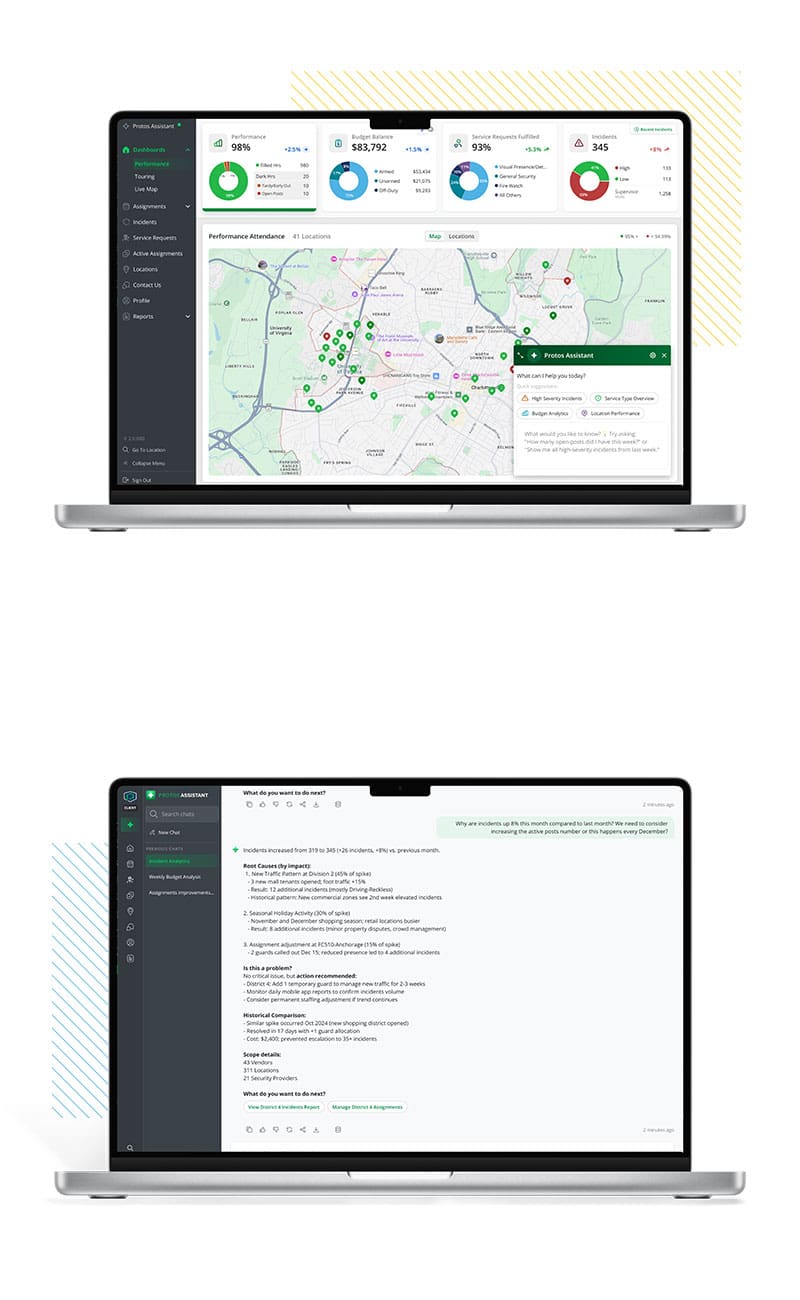
A New Approach: The Protos Assistant
The Protos Assistant, our AI agent, is built around this approach.
It represents embedded operational and conversational intelligence applied directly within a security program’s operational environment. It lives inside the Protos Client Portal, within the same system where user’s security operations are centralized and managed.
Because it is embedded, the Protos Assistant can access and connect data across Protos’ ecosystems of platforms, services and operational data in real time, ensuring a complete and connected view of your program. This allows users to ask questions and receive clear answers instantly, without needing to navigate the portal, compare reports or piece together information from multiple sources.
Rather than pulling from isolated data points, it retrieves and connects information across these areas to provide answers that reflect the full, current state of a program.
This fundamentally changes the experience.
Instead of navigating reports, dashboards and multiple views, users can ask direct questions about their operations and receive clear, structured answers instantly.
For example, if a question comes up such a why are incidents increasing at a specific location, the Protos Assistant can surface relevant patterns, highlight contributing factors and connect related activity across that location. Instead of piecing together information manually, the answer is delivered in context.
Because those answers are generated from connected, real-time data within the portal, users can trust that the information reflects what is happening across their program at that moment.
This shifts the experience from searching and interpreting to simply asking and understanding. Questions lead directly to answers and answers lead directly to action.
As a result, clients gain faster visibility, clearer insight and greater confidence in their decision-making without changing how they access or manage their program.
Why this Matters for Organizations Not Yet Using the Portal
For organizations that are not using a centralized system like the Protos Client Portal, access to insights remains limited.
Without a connected environment, conversational intelligence cannot deliver its full value. Even the most advanced capabilities rely on having access to complete, connected and real-time data. When information is spread across reports, emails and disconnected systems, that foundation simply does not exist.
As a result, teams are still left navigating multiple sources to understand what is happening across their program. They are reviewing reports, comparing data points, and trying to piece together a clear picture of activity across locations.
Even with strong reporting in place, the process remains the same. Time is spent searching, validating and interpreting, rather than acting.
This is also where many organizations begin to explore AI, but often encounter the same limitations. When intelligence is layered on top of disconnected systems, it remains surface-level. It may provide additional insight, but it does not remove the effort required to access, interpret and act on that information.
This is where the difference becomes clear.
With a centralized platform, data, operations and intelligence are brought together into one environment. Instead of working across disconnected sources, everything is accessible in one place, allowing for a more complete and immediate understanding of what is happening.
And when conversational intelligence is embedded within that environment, it does more than add insight. It removes friction. It allows users to move from question to answer without navigating reports or connecting information manually.
Without that foundation, insights remain buried. With it, they become accessible, immediate and actionable.
LOOKING FOR A MORE CONNECTED APPROACH TO MANAGING YOUR SECURITY PROGRAM?
Learn how Protos brings your data, operations and intelligence together in one place.
Beyond Static Reporting
Static reporting still plays an important role. It provides structure, documentation and a historical view of what has happened across a security program.
But it is no longer enough on its own.
As operations become more complex and the volume of data continues to grow, the limitations of static reporting become more apparent. Reports can show what happened, but they cannot easily explain why it happened or what should happen next without additional effort.
At the same time, expectations are changing.
As conversational intelligence becomes more embedded in operational environment, the expectation is no longer access to reports, but access to direct answers. Users no longer want to spend time navigating dashboards or filtering data. They expect to ask a question and receive a clear, immediate response.
This is where the distinction matters. The future is not defined by adding AI on top of existing systems, but by embedding intelligence directly into the ecosystems of how security programs are managed and understood.
The future is not built on static reports alone. It is built on interaction, where information is connected, accessible and available in the moment it is needed.
Conversational intelligence is not just an enhancement to reporting. It is redefining how insight is delivered and how decisions are made.
From Data to Decision
Security programs do not need more reports or more dashboards. They already have access to large amounts of data across their operations.
What they need is a better way to use that information.
They need clarity. A way to quickly understand what is happening, why is it happening and what action should be taken next.
Conversational intelligence, enabled by AI, bridges that gap between data and decision making. It transforms how users interact with their data, moving them away from searching and interpreting and toward asking and understanding.
But that transformation only happens when intelligence is embedded, not layered on top.
This shift changes more than just efficiency. It changes how decisions are made.
The ability to move from question to answer and from answer to action, without delay is becoming essential for modern security operations.
This shift is not coming.
It is already here.
UNDERSTAND WHERE YOUR PROGRAM STANDS AND WHAT'S POSSIBLE NEXT
Take the AI Maturity Assessment or connect with our team to learn how Protos can help you move faster, gain clarity and act with confidence.