

Key Takeaways
- Not every business or location needs the same type of security officer
- Crime risk scores give organizations a data-backed starting point for that decision
- Site-specific factors like incident history and asset value further narrow down the answer
- Multi-location portfolios often have room to right-size coverage without increasing risk
Security budgets are under pressure. If you’re a security director or procurement lead reviewing vendors, you already know this. The question most organizations are quietly asking themselves is whether they’re spending security dollars in the right places.
A blanket security program that applies the same officer type across every location, regardless of crime environment, asset value or incident history, functions more as a default than a strategy. Defaults tend to either over-spend in low-risk environments or under-protect in high risk ones.
The smarter path is matching the level of security to what each site specifically requires. Here’s a framework for doing just that.
The Three Options and What They’re Built For
Before getting into the decision framework, it helps to be clear about what differentiates these three officer types, because the differences go beyond cost. Each tier exists for a reason. The question is which one belongs where.
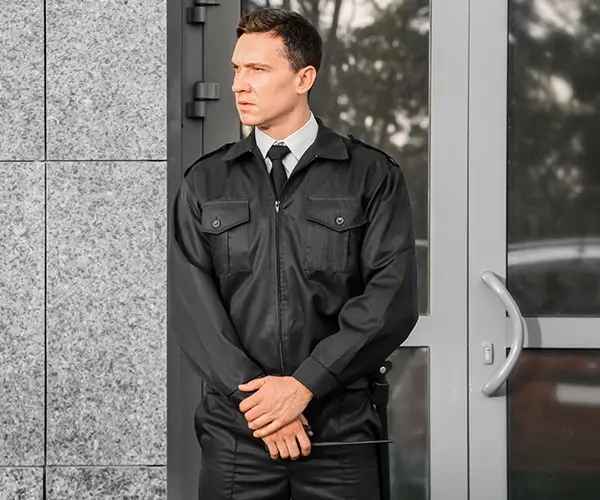
Unarmed security officers
The most widely deployed option. Their primary function is visibility; the signaling of authority that deters criminal behavior before any incident occurs. A uniformed officer at an entrance can change how people move through a space.

Armed security officers
Carry a firearm and meet additional state-specific licensing and training requirements. The firearm doesn’t expand their legal authority, but it does change the behavioral response their presence creates. The visible firearm raises the perceived stakes of testing the environment, which is why armed coverage tends to be deployed in situations where the credible capacity to respond to a violent threat matters as much as the deterrent effect of a uniform.
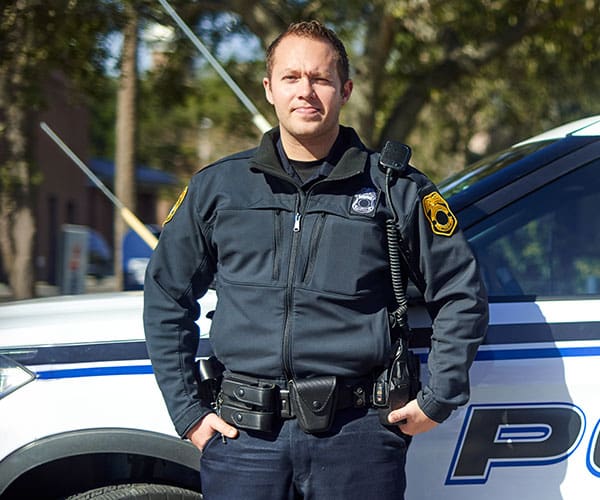
Off-duty law enforcement officers
Active law enforcement personnel working secondary employment. They carry the full weight of their badge, training and legal authority, representing the highest level of perceived deterrence available in private security outside of a full law enforcement presence. They’re the right fit for the highest-risk environments or situations where the credible threat of arrest discourages criminal activity.
Start With the Data: Using Crime Risk Scores to Calibrate Officer Type
The most defensible way to make this decision, and to explain it to leadership, is to back it up with third-party crime risk data.
Tools like CAP Index score a specific address on a scale of 0 to 2,000, where 100 represents the national average. The score draws on demographic data, business statistics and actual crime data to reflect the reality of a specific block.
As a general framework, here’s how that scoring ladder tends to map to officer type:
| CAP Index Score | Risk Level | Officer Type Typically Warranted |
|---|---|---|
| 0-200 | Below average | Security presence may not be needed |
| 200-400 | Moderate | Unarmed security officer |
| 400-800 | Elevated | Armed security officer |
| 800-2,000 | High | Off-duty law enforcement officer |
This kind of data makes a site-by-site conversation possible. A hospital system with 12 locations probably doesn’t need the same officer type at all 12. The downtown urban campus with a score of 650 and a history of assault incidents in the parking structure is a fundamentally different environment than the suburban outpatient clinic with a score of 180 and a nonviolent incident log. Treating them the same wastes money in one place and creates genuine risk in the other.
But the score is just a starting point.
Struggling to find the right security level for your business?
Protos Security can help assess risk across your business and across multiple sites to customize the best security program for your needs.
What the Score Doesn’t Tell You
Crime risk scores reflect the environment around your site but not what’s happening inside it. A few additional factors should shape the final decision:
Incident history:
Your own internal records, including incident logs, manager feedback and security reports, often reveal patterns that no external data source captures. Frequency matters as much as type: nonviolent incidents like trespassing and petty theft call for a different response than a history of physical altercations.
Operational context:
A location stocking high-value inventory attracts a different kind of criminal than one that doesn’t. Motivated, organized offenders behave differently than opportunistic ones, and officer type should reflect which is more likely.
The goal of the presence:
Are you looking for visual deterrence and access control, or do you need genuine intervention authority if something escalates? The answer to that question should drive as much of this decision as any data point.
Brand and environment:
This one is easy to overlook but matters more than one may expect. A uniformed law enforcement officer at a larger grocery or big-box retailer tends to increase customer comfort. At a high-end boutique or specialty healthcare clinic, that same presence can feel out of place and put customers on edge rather than at ease. Concealed armed officers in plain clothes are one solution for environments where authority needs to be present without being prominently displayed. The right security presence reads the room.
Putting it Into Practice: Site-by-Site Decisions Over Blanket Policy
If your organization is looking at ways to reduce security spend, the most productive place to start is asking whether your current officer type matches what each site needs.
For a multi-location portfolio, that usually means running a structured assessment:
- Pulling the crime risk score for each address
- Reviewing internal incident data
- Talking to local managers and checking operational factors
Some locations will remain at their current level. Others may have room to step down from armed to unarmed, or to introduce unmanned solutions like improved access control, lighting or camera coverage, without meaningfully increasing risk.
Know Your Risk, Then Make the Call
There’s no universally correct answer to which officer type a business should use. The right answer fits the specific environment, risk profile and operational context of each site.
A structured assessment helps organizations understand where the risk actually is, so resources go where they’re needed rather than spread evenly across locations that warrant different levels of protection. That’s good for the budget and for the people the security program is meant to protect.
If your organization is heading into a security review, start with the data. Know your scores, know your incidents and make the call site by site.
Protos Security offers guarding and off-duty services that are customizable, so security leaders can match the right solution to each location and adjust as those needs change over time.