

Contact A Security Expert

Contact Us 3 Column (Pardot-2025 new contact form)

The Value of Off-Duty Law Enforcement for Houses of Worship

Share:

Key Takeaways

  • Houses of worship face a distinct threat profile that traditional security staffing isn’t built to handle 
  • The presence of sworn officers creates a measurable behavioral response in would-be offenders before anything happens
  • Off-duty officers bring neighborhood knowledge that changes how they read and manage situations
  • Balancing security with a welcoming environment is a real tension—and one that trained professionals navigate better than armed volunteers
  • Visibility, familiarity and legal authority together drive the psychology of deterrence in congregational settings 

Unarmed security officers serve a real function at houses of worship. They manage access, observe and report, help with traffic between services and provide a visible presence that makes congregants feel welcome. For many institutions, that coverage fits the actual threat level. 

The problem is that the threat environment has shifted. FBI data shows a significant and sustained rise in hate crimes targeting religious institutions since 2018, with violent incidents at places of worship becoming more frequent and more severe. These are not opportunistic events. They are planned, targeted attacks on gatherings of people in confined spaces with limited exits. 

When a congregation has grown, gained public visibility or faces a specific threat history, the question worth asking is direct: does the security model in place have the authority to act when seconds matter? An observe-and-report posture has real value. For congregations whose risk profile has grown beyond that baseline, the question becomes whether that coverage is still the right match. 

Where Unarmed Church Security Officers Fit and When They May Need Support

The psychology here matters more than most organizations realize. 

Perceived deterrence—the degree to which a potential offender believes they’ll be stopped or identified—is one of the most reliable factors in preventing violent incidents at public gatherings. Research on crime deterrence from the National Institute of Justice consistently points to certainty of response as a stronger deterrent than severity of punishment. 

A uniformed off-duty officer standing in a lobby or managing traffic in a parking lot changes the behavioral response of anyone sizing up the location. A person with harmful intent does a risk calculation. The visible presence of someone with clear law enforcement authority—even off-duty—resets that calculation. 

There’s also what happens inside the congregation. When members see a professional presence they recognize and trust, the ambient anxiety that has become part of attending high-profile religious services drops. People can participate. They’re not scanning exits. 

Which Risk Factors Change the Decision

Most congregations where layered coverage makes sense share a recognizable set of characteristics. No single factor is definitive, but several together shift the calculus significantly.

01

Congregation size

Larger weekly gatherings mean more people in a concentrated space and higher visibility as a potential target. 

02

Online and media presence

A congregation that streams services to thousands of viewers is a known target in a way that a smaller, lower-profile institution is not. Online reach extends a congregation’s exposure beyond its physical footprint. 

03

High-profile or controversial leadership

Nationally recognized faith leaders attract a different category of threat. Visibility alone can be enough to draw attention from individuals motivated by notoriety.

04

Attached schools or daycare facilities

Many larger Catholic parishes and Jewish day schools share a campus with a K–12 school. The presence of children during the week extends the vulnerability window beyond weekend services and changes the stakes considerably. 

05

Prior incidents or documented threats

Threat communications, prior disruptions or specific individuals who have been asked not to return are direct signals that coverage should be elevated. 

06

Active community tensions

Institutions associated with publicly divisive issues or that have received negative media attention face an elevated threat environment regardless of congregation size. 

A congregation with several of these characteristics simultaneously, a large membership, a streaming ministry and an attached school, for example, faces a materially different security problem than a small community church with a stable, local congregation. For institutions that cross these thresholds, the question is no longer whether to strengthen security—but how to do it in a way that aligns with both risk and environment.

How Off-Duty Law Enforcement Changes the Threat Environment

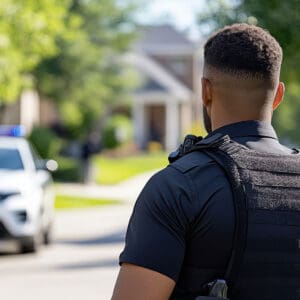
Image of a police officer on a suburban streetFor institutions that cross these thresholds, the question becomes not whether to strengthen their security model but what approach provides both intervention authority and alignment with a worship environment. 

Off-duty law enforcement officers carry the legal standing and use-of-force training to intervene when a situation turns violent. That authority changes what is possible on site before outside law enforcement arrives. 

It also changes the psychology of the space before anything happens. 

Perceived deterrence is one of the most reliable factors in preventing violent incidents at public gatherings. Research from the National Institute of Justice identifies the certainty of a response, the degree to which a potential offender believes they will be stopped, as a stronger deterrent than the severity of punishment after the fact. A uniformed off-duty officer standing in a lobby or managing a parking lot raises that certainty. A person assessing the location as a target does a different calculation when sworn authority is visible. 

The social signaling of authority operates at a level that standard security staffing does not reach. An officer who has worked hundreds of real incidents carries that experience in how they move, how they hold a space and how they interact with people. That signals competence in ways that are difficult to replicate and that most people, including potential offenders, pick up on quickly.

Inside the congregation, the effect works differently. When members see a familiar, professional presence they recognize and trust, the ambient anxiety that has become part of attending high-profile services decreases. Congregants focus on the service rather than scanning the room. Local knowledge compounds this. Off-duty law enforcement who work near their own patrol area often know the surrounding neighborhood in ways no outside firm can replicate. They may recognize individuals near the entrance, understand the context of a situation and calibrate their response accordingly. That kind of risk normalization, accurately reading which situations require force, which need de-escalation and which need nothing at all, is one of the less visible but more valuable things local law enforcement experience provides.  

The Problem With Armed Congregant Volunteers

In states with constitutional carry laws, it is common for some congregation members to attend services while armed. Many churches and synagogues have formalized this into volunteer security teams. The intent is protective. The execution carries serious risk. 

When an incident unfolds and responding law enforcement arrives, officers face an environment they do not fully understand. Armed individuals in civilian clothing, with no clear identification and no coordination with incoming units, create a potential for a tragic outcome regardless of their intentions. Law enforcement arriving to an active situation has seconds to determine who the threat is. A well-meaning volunteer with a firearm can become part of the confusion. 

There is also the liability exposure. If an untrained or improperly credentialed individual takes action during an incident and something goes wrong, the institution carries significant legal risk. Professional off-duty officers bring credentials and departmental accountability. That accountability is what distinguishes them from a volunteer with a concealed carry permit. 

Congregant volunteers can play a supporting role in a broader security posture. They should not form the foundation of it for any institution where the risk profile calls for professional, credentialed coverage. 

Image of church

How Protos Security Supports Houses of Worship

Protos Security operates the nation’s largest off-duty law enforcement network, with access to more than 60,000 off-duty personnel across more than 1,400 agencies. That reach means houses of worship can place officers who know the neighborhood, understand the community and carry the legal authority that congregational security requires. 

For institutions that want layered coverage, Protos also offers remote guarding services that can monitor parking lots and building perimeters without requiring physical presence at every post, and specialized security services including site assessments for institutions facing specific threats or looking for a structured review of their current program. 

Institutions navigating FEMA’s Nonprofit Security Grant Program will find that structured programs with documented coverage decisions and consistent reporting support the audit readiness those grants require. 

Not sure whether your current security model aligns with your risk profile?

Protos can assess your coverage and recommend a right-sized approach for your institution.

Frequently Asked Questions 

What are the signs that a congregation's risk profile calls for layered security coverage?

Congregation size, media visibility, online reach and the presence of attached schools are the clearest signals. Institutions with documented threat communications, a high-profile faith leader or a history of prior incidents should reassess their coverage. When several of these factors are present at once, layering in personnel with intervention authority is worth a structured assessment. 

Volunteers are not easily identifiable as part of the security team when responding law enforcement arrives during an active situation. That ambiguity can create a friendly-fire risk even when a volunteer’s intentions are entirely protective. There is also meaningful liability exposure for the institution if an untrained person takes action during an incident and something goes wrong. Professional off-duty law enforcement brings credentials and accountability that volunteers do not. 

Sworn officers carry legal authority and the trained ability to act if a situation turns violent. Their visible presence changes the behavioral response of anyone assessing the location as a potential target. This is the psychology of perceived deterrence: NIJ research consistently shows that the perceived certainty of a response is a stronger deterrent than severity of punishment.  

Yes. Officers with experience in congregational settings understand how to maintain a welcoming atmosphere while remaining operationally ready. Consistent assignments let officers become familiar faces within the congregation. Plain-clothes coverage reduces the visual weight of the security presence without reducing the deterrence effect that comes with sworn authority. 

FEMA’s Nonprofit Security Grant Program provides funding to help faith-based organizations strengthen physical security measures. Grant funds can support officer coverage, infrastructure improvements and the development of structured security programs with documented standards. 

Protos serves houses of worship of all faiths and denominations, including multi-site churches, synagogues, Catholic dioceses and other religious institutions. For more information, visit protossecurity.com. 

Explore our Religious Institution Security Blog Series

Protos
Headquarters

383 Main Ave, Suite 505
Norwalk, CT 06851, USA
Phone: 203.941.4700

Protos
Headquarters

383 Main Ave, Suite 505
Norwalk, CT 06851, USA
Phone: 203.941.4700

Mark Hjelle

Chief Executive Officer

Mark Hjelle is the CEO of Security Services Holdings, LLC as well as Protos Security and its subsidiaries. Mark is an experienced Chief Executive Officer and Board Member who has led large national business and facilities services firms for nearly 25 years delivering strong top- and bottom-line growth while building high-performing teams with strong culture. Most recently, he was CEO for CSC ServiceWorks, a B2B2C provider of technology-enabled consumer services. Prior to CSC, Mark was President of Brickman/Valleycrest a national provider of exterior landscape and snow removal services. Over the course of his 18-year tenure at Brickman, he held numerous leadership positions in operations, finance and business development. Mark holds a Bachelor of Science degree in Economics from The Wharton School of Business, University of Pennsylvania, a Master of Government Administration from the University of Pennsylvania Fels Institute of Government and a Law Degree from Case Western Reserve School of Law.