


Written by:
Ethan Bruce
National Sales Director
Ethan Bruce is National Sales Director at Protos Security. Ethan works with clients and operational teams to coordinate scalable security programs, improve service visibility and support complex security operations across diverse environments.
Key Takeaways
- A managed off-duty program can eliminate the administrative burden of in-house scheduling and compliance while significantly stabilizing coverage.
- In a self-directed model, hospitals typically have to make do with fill rates of just 50% to 70%. A managed off-duty program can bridge the gap with a reliable, consistent security presence.
- Accelerated pay cycles for off-duty officers can improve retention, leading to a consistent presence that raises healthcare employee engagement scores.
When you go to the hospital, it’s usually the best day or the worst day of your life. In a hospital setting, the emergency department stands as the highest-risk area in the entire building. Anyone can walk right in off the street, and a security officer never knows if the next arrival is a minor medical issue or the aftermath of a violent street conflict.
That’s why a de-escalation-first mindset has to be the very first tool in an officer’s tool belt, with physical force remaining an absolute last resort. Securing high-stakes healthcare environments requires reliable protection, forcing executives to evaluate self-directed vs. managed off-duty programs to ensure proper staffing.
According to data from the Bureau of Labor Statistics, healthcare workers face a disproportionate risk, accounting for nearly 73% of all nonfatal workplace violence injuries in the private sector. I tell folks that security looks extremely different depending on things like the community and the zip code. There’s rarely much of a middle road. These security officers put themselves on the line to protect people, and I want to make sure they get home to their families every night.
The Strategic Decision: Self-Directed vs. Managed Programs
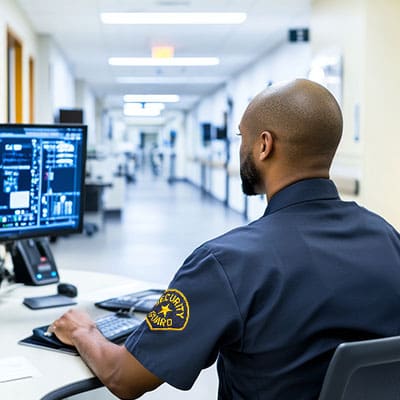 Most hospital systems handle their security staffing internally through a self-directed program, meaning the healthcare organization contracts directly with a local law enforcement agency and manages the scheduling, administration and compliance themselves. In my conversations across the country with chiefs of police, directors of security and facilities managers, I find that many leaders don’t realize that a coordinated, alternative option even exists.
A managed off-duty program shifts the entire burden of coordination, compliance and agency communication to an external specialized partner like Protos Security. This is a major strategic decision for healthcare executives.
Choosing between a self-directed program and a managed model dictates how your organization mitigates risk, handles administrative overhead and utilizes your security budget. When you transition to a managed program, you are trusting a third party to build and run a program from scratch.
The Metric That Exposes the Gap: Fill Rate
The true health of an off-duty program is measured by one key metric: fill rate. Fill rate calculates whether your facility is actually receiving the security coverage you are paying for. In a self-directed program, hospitals typically experience fill rates of only 50% to 70%. When a shift goes unfilled, it represents a massive gap in security.
In one example where we took over a healthcare facility, they had been struggling with a fill rate near 50%. Within six weeks of transitioning to a managed off-duty program, Protos stabilized their schedule and drastically reduced their unfilled shifts.

The Organizational Impact of Open Posts
When organizations like the Joint Commission or DNV conduct site surveys, an empty security officer post can trigger an immediate finding. Under the Joint Commission’s strict standards, an unmanaged environment or an empty critical safety post can directly cause an organization to lose ground on its accreditation matrix. A ding like that can directly impact hospital accreditation and federal funding.
Under a self-directed model, the hospital staff has to scramble to put together its own remediation plan. A managed off-duty program like ours at Protos eliminates that administrative burden by actively managing security officer scheduling, coordinating with local law enforcement agencies, and working to backfill open shifts. By providing the required documentation and proactive action plans, our team helps healthcare leaders demonstrate continuous risk mitigation without overwhelming internal resources.
The Hidden Cost of Doing It Yourself
Running an in-house off-duty program comes with significant costs that leaders rarely factor into their budgets. On average, hospital systems spend roughly a half-FTE of internal staff time just managing schedules, coordinating coverage gaps and handling complex pay structures.
Managing individual security officers also creates administrative friction when it comes to W-2s vs. 1099s. Entrusting these pieces to an external coordinator frees up your internal team to focus on core operations while delivering more value per security dollar.
UNMATCHED, END-TO-END TRANSPARENCY
See how Protos coordinates guarding and off-duty law enforcement services through one platform with real-time visibility and a single point of contact.
Behavioral Dynamics and Retention
The success of off-duty law enforcement relies heavily on behavioral dynamics. Standard hospital payroll cycles operate on a bi-weekly basis, but we implement an accelerated 48-hour pay cycle for off-duty security officers. Realistically, when you pay these folks faster, they want to retain those shifts.
Fast compensation drives officer retention and creates a consistent schedule of repeat officers. When the same security officers show up regularly, they establish a social signaling of authority and build familiarity among clinical staff. They get to know the officers by name, which directly improves employee engagement scores.
Depth of Coverage: Looking Beyond a Single Agency
A single-agency contract has built-in risks. If a local police department or sheriff’s office receives an all-hands emergency call, your hospital coverage can vanish instantly. Coordinating across multiple agencies is what keeps posts filled.
I often pull up our labor and intelligence software to show healthcare leaders an example of ours in Memphis, Tennessee. In a three-month period within a 10-mile radius of Memphis, we coordinated with 37 distinct law enforcement agencies to maintain continuous hospital coverage. That’s just that one area. With a network of thousands of off-duty officers across thousands of agencies, a managed program provides a level of coordination that a single-agency contract just cannot match.
Frequently Asked Questions
To help security leaders evaluate their approach, I want to recap with some answers to the most common questions we see regarding healthcare off-duty models:
What is a self-directed off-duty security program?
A self-directed off-duty security program is an in-house model where a healthcare facility directly contracts, schedules and manages security officers independently.
How do self-directed and managed off-duty programs compare when it comes to off-duty fill rates?
In a self-directed model, hospitals typically have to make do with fill rates of just 50% to 70%. A managed off-duty program can bridge the gap with a reliable, consistent security presence.
How does an off-duty program affect Joint Commission or DNV accreditation?
A Joint Commission or DNV accreditation survey can ding hospitals for unstaffed security posts, directly impacting hospital funding and compliance status.
What does a managed off-duty program cost compared to running it in-house?
A managed off-duty program reduces internal overhead by eliminating roughly a half-FTE of administrative labor, delivering greater overall value per security dollar thanks to minimized staffing gaps.
A Strategic Approach to Safety with Protos Security
Hospital leaders aren’t doing it all wrong if they utilize a self-directed off-duty program. It’s just that a coordinated, managed off-duty program tends to be a more efficient way to run something your organization is already paying for.
Protos Security offers off-duty services to get you the high fill rates, data-backed reporting and executive accountability you need to protect your healthcare community and your resources.