

Key Takeaways
- Budget pressure hits security hard. The line items look cuttable. The consequences often are not.
- Off-duty law enforcement brings authority and capability, not just presence. Removing it changes how people behave on site before any incident occurs.
- The smarter move is reshaping your security mix site by site, not making blanket cuts across your portfolio.
- Most of what you lose from a downgrade won’t show up in the security budget. It shows up in incident reports, liability exposure and employee retention.
Security budgets are under pressure. That’s the reality security directors are living with right now. Tariffs, hiring freezes and cautious spending have put a target on every line item, and physical security is rarely exempted from that conversation.
One question keeps coming up: Where can we cut security spend without increasing risk?
The honest answer is that some cuts make sense and some create costs that land in a completely different budget. The problem is that most organizations are running this analysis in the wrong order, starting with the hourly rate and working backward. A smarter process starts with what each site actually needs and prices from there.
This checklist is built for security directors and procurement leads heading into a budget review. Use it before the decision gets made.
Before You Change Anything: The Executive Security Budget Checklist
01
Pull crime risk scores for every site in your portfolio.
Third-party tools like CAP Index CRIMECAST score a specific address on a 0–2,000 scale, where 100 is the national average. This is the fastest way to see which locations are operating in genuinely different threat environments. A site scoring 180 and a site scoring 650 should not have the same officer type. If they do right now, you may already have room to right-size without adding risk.
For a full breakdown of how crime risk scores map to officer type decisions, see Commercial Security Officer Types: Matching Armed, Unarmed and Off-Duty to Your Actual Risk.
02
Review internal incident logs before you look at external data.
Crime risk scores reflect the environment around your location. They do not capture what is happening inside it. Pull the incident history from each site. Look at frequency and type. A location with a nonviolent incident log and a low CAP Index score is a different conversation than one with a history of physical altercations, regardless of what the area score says.
03
Understand what off-duty officers are actually providing before you move them to standard guarding.
This is where most cost-cutting decisions go wrong.
Off-duty law enforcement officers are active sworn personnel working secondary employment. That sworn status changes almost everything about how a post functions. They carry an average of roughly 833 hours of basic academy training, maintain active arrest authority and have direct radio access to local dispatch. A standard security officer license typically requires between 8 and 40 hours of training.
The gap in training is real. So is the gap in legal authority on the ground.
For a full breakdown of what off-duty law enforcement actually brings to a post and what changes when you remove it, see The Hidden Cost of Downgrading From Off-Duty Law Enforcement Security.
04
Do not confuse consistency with capability when evaluating an off-duty program.
Off-duty officers have full-time jobs. That is why they are off-duty. The program is not designed to deliver the same person every shift, and that is a frequent source of misunderstanding. When an off-duty program gets blamed for inconsistency that was never its purpose, you risk cutting something that was working based on a metric that does not apply.
The value of off-duty coverage is capability and authority, not shift-to-shift uniformity. Make sure whoever is running the analysis understands that distinction.
05
Calculate the perceived deterrence effect before you remove it.
A uniformed law enforcement officer in a lobby or parking structure is one of the most powerful forms of social signaling of authority available in a commercial environment. Decades of situational crime prevention research show that perceived deterrence, specifically the belief that getting caught is likely and will carry real consequences, is a stronger behavioral lever than almost any other security factor. A Department of Justice review of deterrence research found that the certainty of being caught matters more than the severity of punishment.
When that visible authority is removed, the behavioral response from people weighing whether to test your site changes. The incidents that quietly did not happen last quarter may happen next quarter. That number will not appear on any report tied to the security budget.
06
Factor in the internal perception shift among your employees.
When employees see a sworn officer at the front desk, the implicit message is that leadership takes their safety seriously. A less trained, less authoritative presence sends a different signal. This is risk normalization in reverse: the environment communicates what level of threat the organization expects, and a downgrade tells employees the organization has decided the risk is manageable at lower cost.
For workers in healthcare, retail and financial services, where workplace violence is on the rise according to OSHA, that message lands hard. It shows up in retention, morale and, in unionized environments, at the bargaining table.
07
Check whether your security presence matches your brand environment.
Security is part of the experience a customer has at your location, whether it appears in brand guidelines or not. A visible, authoritative officer at a grocery or big-box retailer typically increases customer comfort. The same presence at a high-end boutique or specialty clinic can create the opposite effect.
The right security presence reads the room. This applies in both directions: a mismatch created by downgrading a previously trusted presence can signal that the organization has pulled back from the community. Customers pick up on it, particularly in categories where they can shop elsewhere without needing a reason.
08
Assess the liability exposure if training standards drop.
When an incident occurs on site, the training standard of the responding officer matters legally, not just operationally. An off-duty officer acting within the scope of law enforcement training has a clear standard of care. A lightly trained security officer making the same call operates under a standard that is frequently contested after the fact. That is not a theoretical risk. Plaintiffs’ attorneys and insurers both understand it.
Savings from a downgrade can disappear in a single incident where inadequate training becomes the central question in litigation.
09
Map where costs actually resurface when security is cut.
The savings from a security line item reduction rarely stay in the security budget. They tend to reappear in incident-related costs, insurance posture, legal exposure and brand impact. Before approving a cut, ask where those costs would land if something does happen. If the answer is a different budget, a different department or an event with reputational consequences, that belongs in the analysis.
10
Reshape the mix rather than making blanket cuts.
Wholesale dropping a program is rarely the right call. What most multi-location portfolios actually have room to do is adjust the officer type mix site by site: stepping down from armed to unarmed where crime scores support it, introducing remote monitoring or improved access control at lower-risk locations and preserving off-duty coverage where the threat profile genuinely warrants it.
That kind of structured review produces defensible decisions. A procurement target applied across the portfolio does not.
What Does a Smart Security Budget Review Actually Look Like?
It starts with the data. Crime risk scores for each address, internal incident history, operational context (cash handling, lone-worker shifts, asset value, alcohol service) and a clear read on what type of incident is most likely at each site.
For the sites where an incident could mean a violent confrontation or an active threat, the staffing decision is not really a cost question. An unarmed officer in that environment cannot stop it. They can only witness it and call for help.
For the sites where the most likely incident is property-related and a call to local law enforcement resolves it, there may be real room to adjust coverage downward without meaningfully increasing risk.
The point is to do that analysis site by site, with data, before anything changes.
Where Protos Security Fits Into This
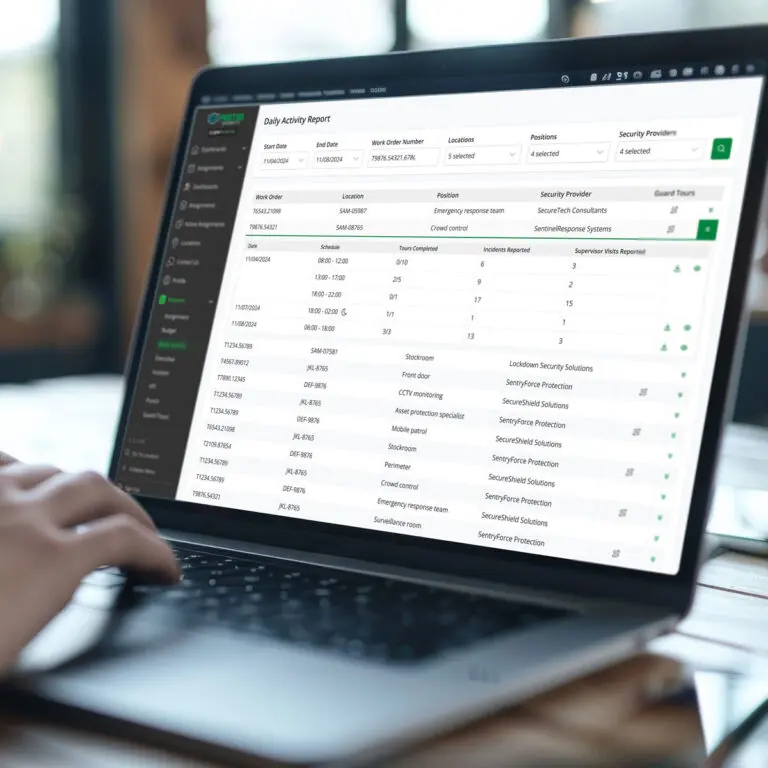
Protos was built to help organizations run exactly this kind of analysis. The off-duty law enforcement network covers more than 60,000 off-duty personnel across over 1,400 agencies. The guarding services program coordinates thousands of locally owned vendors. Both can be mixed, matched and adjusted as site needs change.
Protos bills for time delivered, not time scheduled, and provides the data to show what you got for what you paid. If your organization is heading into a security review, that kind of visibility makes the conversation with leadership a lot easier.
Contact us to talk through what is on the table. We can help you figure out where the real savings are, and where a cut would cost more than it saves.