

Churches, synagogues, dioceses and other faith communities are growing. Many now operate across multiple campuses in different buildings, neighborhoods and sometimes cities. That growth is a blessing. Managing security across all of it is a different story.
When a congregation spans multiple sites, the person responsible for safety is no longer thinking about one property. They are managing an enterprise security program. They must coordinate officers, monitor post coverage, respond to incidents and prevent coverage gaps, often with a lean team and a tight budget.
Federal funding reflects that shift. FEMA’s Nonprofit Security Grant Program continues to allocate significant funding to help faith-based and nonprofit organizations strengthen physical security measures, acknowledging the increased risk environment many institutions now face.
At scale, security becomes an operational discipline. It requires visibility, consistency and control.
The Multi-Site Challenge
What Is Multi-Site House of Worship Security?
Multi-site house of worship security is a centralized approach to managing security across multiple campuses, ensuring consistent standards, visibility and response coordination.
A single-campus congregation has one set of doors to watch, one parking lot and one service schedule. A multi-site ministry multiplies that complexity.
The multi-site church model has grown from roughly 200 churches in 1999 to more than 5,000 by 2012, with some estimates exceeding 10,000 today. Seventy percent of megachurches now operate in a multi-site format. That growth has reshaped how ministries operate across the country.
Some campuses run Saturday services. Some host mid-week programs or special events. Some sit in dense urban areas. Others operate in smaller towns where coverage is harder to source.
The security leader overseeing all of this cannot be everywhere at once. They need centralized visibility across locations. What they often get instead is reactive reporting and a different point of contact at every vendor.
For enterprise religious institutions, that structure creates risk. Inconsistent standards, delayed reporting and open posts across campuses erode control quickly.
One Portal, All Your Sites
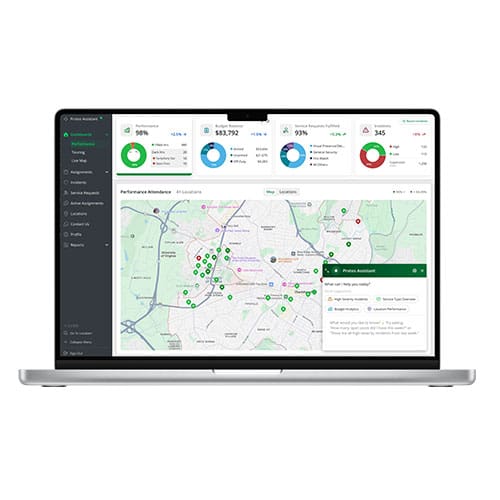
Protos Security built its client portal specifically for distributed organizations.
If a security officer is scheduled to be on-site at one of your locations and has not clocked in five minutes after their shift starts, the Protos dispatch center receives an automatic alert. The team contacts the local vendor partner, identifies the issue and communicates the update to the site. You are not waiting until the next morning to discover a post was uncovered.
From the portal, a security director can see all campuses at once: who is on-site, whether posts are covered and how each location is performing. It is not a stack of reports. It is a real-time operational view of the entire program.
For multi-site ministries, that level of visibility supports executive oversight, audit readiness and budget control across cost centers.
Centralized Governance Across All Campuses
Multi-site ministries operate as enterprises. Security must operate the same way.
A security director should be able to see the entire program at a glance: which posts are covered, which officers are on site and how each campus is performing. That visibility supports executive accountability and consistent standards across locations.
Without centralized oversight, gaps appear quickly.
Managing Security Across Multiple Campuses?
See how Protos coordinates guarding and off-duty law enforcement services through one platform with real-time visibility and a single point of contact.
The Right Resource for the Right Situation
Not every campus carries the same exposure.
A small community church in a quiet neighborhood has different needs than a large congregation with regional visibility and thousands of weekly attendees. A diocese with parishes spread across a metro area may require different service levels at each location.
Enterprise security programs must define deployment standards. When does a campus require a security officer? When does off-duty law enforcement make sense? What criteria trigger escalation?
Multi-site ministries often host special events, community outreach programs or high-attendance services that require temporary security increases. With 24/7 dispatch support, organizations can request additional coverage quickly. In many markets, unarmed security officers can be deployed in as little as 90 minutes. Off-duty law enforcement coverage can often be arranged within hours when elevated deterrence is required.
Security should scale with the moment.
Off-duty law enforcement brings sworn authority and the ability to act immediately if a situation turns violent. In higher-risk environments, visible authority strengthens perceived deterrence.
For smaller congregations or lower-risk campuses, traditional guarding services remain appropriate. The key is structured decision-making across the organization rather than ad hoc site-by-site choices.
Protos works with thousands of local owner operator security vendors along with the nation’s largest off-duty law enforcement network: more than 60,000 personnel across over 1,400 agencies. That reach supports ministries operating across regions, especially when urgent coverage needs arise.
One Relationship, Not Many
In multi-site environments, the question is not which single security model is best. It’s how to deploy the right mix of resources consistently across all locations.
Multi-site organizations often juggle multiple vendors, contracts and communication channels just to keep locations covered. Every additional point of contact adds friction and creates gaps.
With Protos, you have one account relationship and one platform, regardless of how many campuses you operate or how varied their risk profiles may be. Protos coordinates local partners while providing centralized oversight and 24/7 dispatch support.
Security is a cost center. Gaps in coverage carry cost as well. So does fragmented oversight.
Multi-site ministries need structure, visibility and scalable coverage that aligns with enterprise responsibility.
Ready to build a smarter security program across your campuses?
Protos works with multi-site churches, synagogues, Catholic dioceses and other religious institutions to deliver centralized oversight and scalable coverage.

Frequently Asked Questions About Multi-Site House of Worship Security
When should a house of worship use off-duty law enforcement?
Off-duty law enforcement is often appropriate when a campus has higher visibility, larger attendance, prior incidents or an elevated risk profile.
Sworn officers bring legal authority and the ability to act immediately in a violent situation. Their visible presence also strengthens perceived deterrence in religious settings.
Is unarmed security still appropriate for some campuses?
Yes. Many campuses operate in lower-risk environments where trained unarmed security officers are the right fit.
The key is defining deployment criteria across the organization so decisions are consistent and aligned with risk exposure.
How do multi-site ministries standardize security across locations?
Standardization across campuses requires four building blocks: clear policies that define coverage expectations at each site, vendor consolidation so all locations operate through a single accountable relationship, reporting systems that provide real-time visibility into post coverage and officer attendance and escalation criteria that define when and how security levels should increase. Without these in place, each campus tends to operate independently, creating inconsistent protection and blind spots for leadership.
How can a security director monitor multiple campuses at once?
Enterprise programs need real-time visibility into post coverage, officer attendance and incident activity.
A centralized platform allows leadership to see all locations in one view rather than relying on reactive reports or separate vendor communications.
Does FEMA funding support multi-site religious institution security?
Yes. FEMA’s Nonprofit Security Grant Program provides funding to help faith-based organizations strengthen physical security measures.
Multi-site organizations can use grant funding to improve infrastructure, enhance deterrence and implement structured security programs across campuses.