

By: Katie Irvine, Director of Product Marketing
ISC West has always been a reliable signal for where the security industry thinks it’s going. But this year, it felt more like a signal for where it’s being forced to go.
With more than 30,000 attendees, hundreds of exhibitors and a packed agenda of sessions and keynotes, ISC West 2026 had all the scale and energy you’d expect. But beneath that, there was a noticeable shift in tone, one that showed up consistently, whether you were walking the show floor or taking part in conversations with operators, integrators, prospects, clients or technology providers – AI was everywhere and so was the messaging around it.
This year, however, it felt like more than a headline. AI had become the expectation.
For the past few years, AI has been positioned as the future of security. At times, it felt more like a signal of innovation rather than a reflection of reality. At ISC West 2026, we saw that framing starting to fall apart.
The questions being asked are sharper now.
It’s no longer “Is it AI-powered?”
But instead “What does it actually do for me/for my security program?” or “Does it make my operation better, or just more complex?”
Because in a space like security, complexity doesn’t scale. It compounds. And eventually, it breaks.
AI Is Not the Product
One of the more grounded perspectives we brought into the event, and saw echoed in the conversations that carried the most weight, is: AI isn’t the product. It’s an enabler.
No one is investing in AI for its own sake. They’re investing in outcomes that come from AI: faster response times, fewer missed incidents, more efficient coverage, better visibility across their environment.
AI, at its best, is what helps close the gap between what’s happening and what gets acted on.
Jason Speilfogel, Protos Product Manager, put it in a way that stuck with me throughout the week: the role of AI isn’t to replace people, it’s to remove the friction that slows them down.
That framing feels especially important right now, as the industry navigates a wave of messaging around automation and autonomy. Because the reality is, most security teams aren’t looking for replacements. They’re looking to be more effective.
What they need is less noise and greater confidence in the decisions they’re making under pressure. The most compelling applications of AI at ISC West recognized that. They weren’t designed to do everything, but to intervene in the moments that matter and step back when they don’t.
The Real Problem Was Never Data
Walking the show floor, it was clear that the industry doesn’t have a shortage of technology. If anything, the opposite is true.
Between video systems, access control platforms, monitoring tools and the growing number of AI-driven analytics layered on top, organizations are operating in increasingly complex environments. But more technology hasn’t solved the core problem, it’s only made it more visible. Security teams aren’t struggling because they lack data; they’re struggling because turning that data into clear, timely action is still harder than it should be.
What stood out at ISC West wasn’t just how many solutions are leveraging AI, but how many are starting to focus on making data usable, not just available. That’s where AI begins to move from concept to capability.
From Innovation to Accountability
If last year’s event was about what’s possible, this year felt like a checkpoint. An inflection point where the industry is starting to hold itself to a higher standard. It’s no longer enough to demonstrate innovation, because now you have to demonstrate impact.
Across every conversation in our booth, the same theme kept surfacing: security buyers are more informed, expectations are higher and patience for vague value is running thin. The conversation is moving beyond features and toward outcomes, beyond capabilities and toward accountability, forcing clearer answers to questions about real-world performance, workflow integration and whether AI solutions actually make teams more effective.
Where This Becomes Real
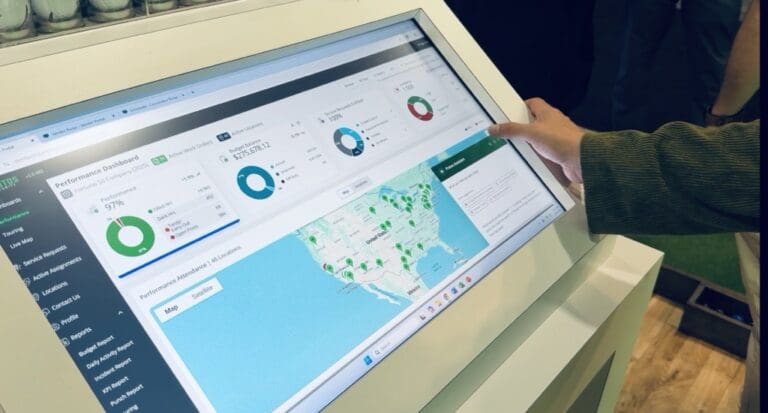
What often gets lost in booth demos or marketing materials is the reality that security technology doesn’t operate in ideal conditions.
It operates within real organizations, shaped by competing priorities, constrained resources and workflows that aren’t always built for efficiency.
That’s where even the most advanced solutions can fall short. ISC West made it clear that the next phase of the industry isn’t just about building smarter technology, but about ensuring it works in the real world, that it is operationalized, integrated and capable of driving meaningful action. Because insight alone isn’t enough. If it doesn’t translate into a better outcome, it’s simply noise, regardless of how sophisticated the technology may be.
What stood out at ISC West wasn’t just the advancement of AI, it was the pressure it’s putting on the industry. It’s exposing the gap between what’s promised and what’s delivered, what’s built and what’s actually used and ultimately the disconnect between innovation and execution. And in doing so, it’s raising the bar, not for who has the most features, but for who can make those features work consistently in real environments.
The Industry isn’t Waiting on What’s Next
ISC West 2026 didn’t introduce a new narrative, it sharpened the one already in motion. The industry isn’t waiting for the next breakthrough; it’s demanding that existing technology deliver real results. AI is central to that conversation, but it’s no longer enough to simply have it.
What’s changing, especially from a product marketing standpoint, is how value needs to be communicated. Buyers are asking harder questions, and the answers can’t live in features alone; they have to show up in real-world performance.
In that environment, execution, clarity and accountability aren’t just differentiators, they’re the story.
And from my point of view, it’s a much more interesting one to tell.
How Mature Is Your Security Operation’s AI Intelligence?
Answer five short questions to assess how quickly and effectively your security program turns operational data into executive-ready intelligence.