

Key Takeaways
- Houses of worship face a distinct threat profile that traditional security staffing isn’t built to handle
- The presence of sworn officers creates a measurable behavioral response in would-be offenders before anything happens
- Off-duty officers bring neighborhood knowledge that changes how they read and manage situations
- Balancing security with a welcoming environment is a real tension—and one that trained professionals navigate better than armed volunteers
- Visibility, familiarity and legal authority together drive the psychology of deterrence in congregational settings
The threats facing houses of worship have changed. Mass shootings at synagogues, churches and mosques are no longer rare events confined to the news cycle—they’re part of the security calculus that religious leaders, facility managers and congregations now have to plan around. Since 2018, the FBI has documented a significant rise in hate crimes targeting religious institutions, with violent incidents at places of worship becoming more frequent and more severe.
That shift changes what kind of security actually works—and why.
The incidents that happen at houses of worship are, unfortunately, often violent rather than opportunistic. A theft deterrent posture handles shoplifting. It doesn’t stop someone who has chosen a specific target and come prepared. The threat profile is different, which means the right security response has to be different too.
That’s where off-duty law enforcement fits in a way that most security staffing can’t replicate.
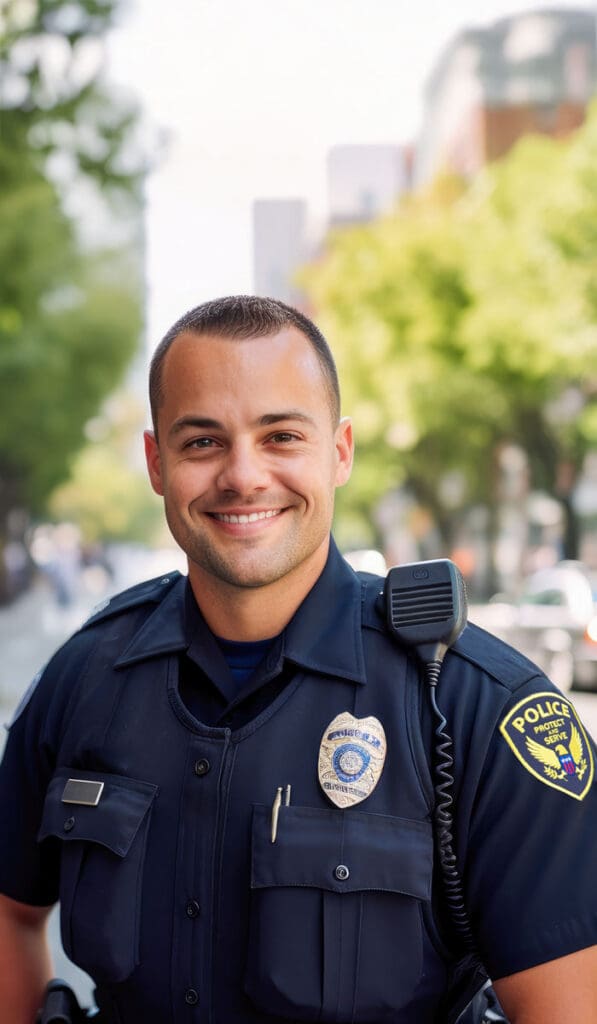
What does off-duty law enforcement bring that traditional security doesn't?
The most direct answer: legal authority, use-of-force training and situational judgment built from years in the field.
A traditional security officer in an observe-and-report role can document what happened. An off-duty sworn officer can intervene. In an environment where seconds matter—a sanctuary with limited exits, a congregation gathered in a confined space, a parking lot where an incident starts before anyone is inside—that difference is significant.
The FBI’s research on active shooter incidents consistently shows that outcomes improve when trained individuals can respond immediately, before outside law enforcement arrives. Off-duty officers working a site are already there. They know the layout. They know the congregation. They can act.
There’s a behavioral dimension to this as well. The social signaling of authority that a sworn officer projects, even in plain clothes, is different from what a standard security officer communicates. People pick up on it. So do potential offenders.
How does a uniformed officer change the threat environment before anything happens?
The psychology here matters more than most organizations realize.
Perceived deterrence—the degree to which a potential offender believes they’ll be stopped or identified—is one of the most reliable factors in preventing violent incidents at public gatherings. Research on crime deterrence from the National Institute of Justice consistently points to certainty of response as a stronger deterrent than severity of punishment.
A uniformed off-duty officer standing in a lobby or managing traffic in a parking lot changes the behavioral response of anyone sizing up the location. A person with harmful intent does a risk calculation. The visible presence of someone with clear law enforcement authority—even off-duty—resets that calculation.
There’s also what happens inside the congregation. When members see a professional presence they recognize and trust, the ambient anxiety that has become part of attending high-profile religious services drops. People can participate. They’re not scanning exits.

What are the risks of relying on congregant volunteers or informal armed members instead?
Many congregations, particularly in states with broad concealed carry laws, have members who are armed and willing. Some churches and synagogues have formalized this into volunteer security teams. The intent is protective. The execution carries real risk.
When an incident unfolds and responding law enforcement arrives, they face an environment they don’t fully understand. If armed individuals in civilian clothes are present and the scene is still active, officers arriving have seconds to determine who the threat is. As research on officer decision-making under stress documents, those split-second judgments carry real consequences. A congregant with a firearm who isn’t clearly identified creates a potential for a tragic outcome even when their intentions are entirely protective.
There’s also the legal exposure to consider. If an untrained or improperly credentialed individual takes an action during an incident and it goes wrong, the institution has significant liability. Professional off-duty officers bring their training, their credentials and their departmental accountability with them.
This doesn’t mean armed volunteers add nothing. But it does mean they shouldn’t be the primary plan for church security.
How does congregation size and visibility change the security calculus?
The larger and more visible the institution, the more the threat profile shifts. A small community church in a rural area faces different risks than a megachurch with a television ministry and a widely known pastor. According to research from the Center for Homicide Research and broader threat pattern analysis, high-profile religious figures and institutions attract a different category of threat—individuals who are motivated by notoriety as much as ideology.
Online presence amplifies this. A congregation streaming services to thousands of viewers is a known target in a way that a smaller, lower-profile church isn’t. The threshold for moving from unarmed security staff to off-duty law enforcement coverage drops as visibility increases.
Institutions with schools or childcare facilities attached—common among larger Catholic parishes and Jewish day schools—have an additional layer of complexity. The presence of children changes the risk profile and the behavioral stakes for anyone considering the location as a target.
What does local knowledge actually mean in practice?
Off-duty officers working near their own patrol area or community often have context that no outside security firm can replicate. They may know individuals in the surrounding neighborhood. They recognize patterns. They understand what a normal day looks like in that part of the city.
This plays out in small interactions that prevent escalation. A person loitering near the entrance may be well known to a local officer—someone with a history of mental health crises who needs a calm, knowledgeable interaction rather than a confrontational one. An outside security officer following a protocol doesn’t have that context. A neighborhood officer often does.
That kind of risk normalization—correctly calibrating which situations require force, which require de-escalation and which require nothing at all—is one of the less discussed but more valuable things that local law enforcement knowledge provides.
What should religious institutions look for when evaluating security coverage?
The questions worth asking are practical ones.
Does the coverage match the actual threat profile? A small congregation in a low-risk area and a nationally televised ministry are not the same security problem.
Are the officers working the site appropriate for the environment? Not every off-duty officer is suited for every setting. An officer who works congregational security well understands the need to maintain a welcoming atmosphere while staying operationally ready.
Is there a communication structure? Officers working a site should have a clear point of contact in leadership, know about any specific concerns—custody disputes, prior incidents, threat communications—and have a protocol for reporting observations back through that channel.
Is the coverage consistent? Familiar faces build trust with congregations over time. Rotating a different officer through every week produces a lower level of integrated deterrence than the same professionals showing up week after week.
Concerned about your institution’s current security posture?
Protos can help you evaluate your coverage model and determine whether off-duty law enforcement is appropriate for your size, visibility and risk profile.
What changes for multi-campus or diocesan systems?
Security decisions look different when you’re responsible for more than one location. A regional church network, a diocese managing dozens of parishes, a synagogue system with satellite campuses or a ministry that has grown beyond its original building. These organizations can’t treat security as a site-by-site problem. The decisions have to scale.
That means thinking about policy consistency first. If one campus has professional off-duty coverage and another relies on armed volunteers, the institution carries uneven liability exposure across its own portfolio. When something goes wrong at the under-resourced location, the gap becomes a legal and reputational problem for the whole organization.
Reporting matters at this level too. Leadership at diocesan or enterprise scale needs visibility into incidents, near-misses and threat communications across all locations, not just the ones that escalate. A custody dispute flagged at one campus may be relevant to another. A threat communication received at headquarters may affect site-level decisions. Without a consistent reporting structure, that information stays siloed.
Vendor fragmentation is another real risk. Organizations that have assembled location-by-location security arrangements over time often end up with inconsistent officer quality, no unified point of contact and no coordinated response plan if an incident affects multiple sites simultaneously.
Protos works with multi-campus institutions to build coverage models that standardize across locations without removing the local knowledge that makes off-duty law enforcement effective in the first place. One point of contact. Consistent standards. Officers who know their specific community.

How does Protos Security approach religious institution coverage?
Protos Security operates the nation’s largest off-duty law enforcement network, with access to more than 60,000 off-duty personnel across more than 1,000 agencies. That reach means Protos can place officers who know the neighborhood, understand the community and carry the legal authority and training that institutional security at houses of worship requires.
Through Protos’ off-duty services, religious institutions get a single point of contact, 24/7 coordination and the ability to scale coverage for high-attendance events like High Holy Days, Easter weekend and large community gatherings without standing up an entirely separate vendor relationship.
For institutions that want layered coverage, Protos also provides remote guarding services that can monitor parking lots and building perimeters without requiring physical presence at every point. And for institutions facing specific threats or requiring more comprehensive assessments, specialized security services, including site assessments, are available.
The approach is built around matching the right resource to the actual situation—not applying the same model regardless of context.
Houses of worship deserve to remain what they’re meant to be: open, welcoming spaces where people gather without fear. Getting church security right is what makes that possible. The presence of trained, credentialed professionals with real authority in these spaces does more than prevent incidents. It changes the behavioral environment of the space itself, so the congregation can focus on why they came.