How Security Presence Shapes Safety in High-Risk Healthcare Settings

Share:

Key Takeaways

  • A visible healthcare security presence acts as a stabilizing anchor, and officers trained in de-escalation can calm tense situations during medical crises. 
  • Strategic security placement helps protect clinical staff from burnout by mitigating risk and encouraging a culture of incident reporting. 
  • Relying solely on passive, remote monitoring tools without an integrated physical security presence can leave critical operational gaps that lead to costly damage. 
  • Healthcare-specific safety requires an approach that balances an authoritative visual presence with empathetic, patient-first care and regulatory compliance.

Healthcare settings are inherently high risk, operating as complex ecosystems where clinical demands and safety risks overlap for patients and healthcare providers. Within 24/7 emergency departments, psychiatric units and late-night urgent care centers, clinical staff manage unpredictable patient surges alongside intense emotions as the norm. 

Managing the physical security of these environments requires a strategy that takes many key factors into consideration: physical barriers, technologies and diverse locations within a single network. Establishing a proactive healthcare security presence depends heavily on understanding human behavior and how patients and healthcare professionals engage with authority. 

Scaling a Healthcare Security Presence Across Diverse Networks

When healthcare networks look to scale their security strategies to match changing threat levels, a one-size-fits-all approach leaves facilities exposed to unmitigated risks. Many healthcare systems use a managed services model to achieve consistent protection across multiple locations. 

At Protos Security, we help healthcare systems dynamically deploy specialized security professionals and avoid placing undue burden on internal administrative resources. A managed off-duty program gives healthcare facilities security coverage tailored to the unique demands of their environment. 

De-Escalating Distress With a Visible Security Presence

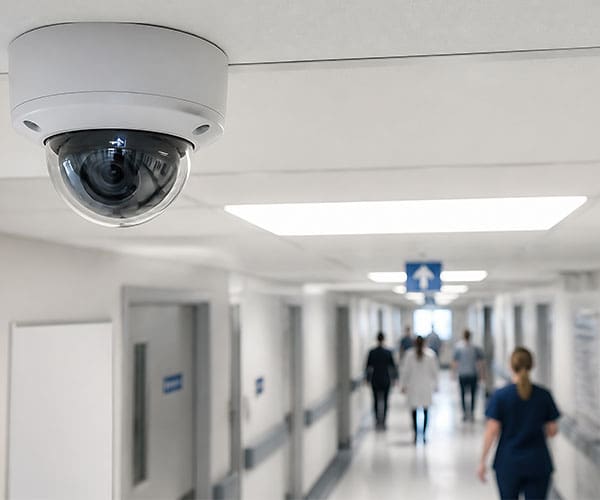
security camera in hospital hallway

Security leaders in healthcare settings have to be able to address how and why a physical security presence fundamentally changes human behavior (i.e., concerns and reactions) during acute points of stress and emotionality. 

Specifically, a clinical environment reshapes the social signaling of authority. In a traditional office or perhaps a brick-and-mortar storefront, authority figures generally signal compliance with routine rules. In a high-risk healthcare setting though, these signals serve an even deeper psychological purpose: they counteract emotionally charged feelings of distress. Patients in extreme pain or family members dealing with sudden trauma have narrowed cognitive processing abilities, which can lead to more volatility socially. 

Physical Security vs. Remote Monitoring 

A highly visible security officer trained for the particular type of healthcare environment, be it an urgent care or a psychiatric unit, can act as a stabilizing presence. Their being there and responding according to the situation at hand communicates that the environment is secure, monitored and under control, which can not only de-escalate high-risk situations, but also ease concerns for patients, families and clinical staff during an already stressful time. 

Remote monitoring technology can provide critical site-wide intelligence, and it is particularly beneficial when paired with a physical security presence. While scaling back an onsite security presence may seem like a cost-saving measure, a lack of visible security coverage in high-traffic areas can allow chaotic behaviors to escalate faster. An integrated strategy that combines advanced technology with an onsite presence delivers the most complete protection. 

A Smarter Way to Think About Security Spend


A significant operational challenge in high-risk medical environments is risk normalization, which occurs when healthcare staff experience verbal abuse, threats or minor physical aggression so frequently that they begin to view these disruptions as a regular part of the job. The American Hospital Association (AHA) released a study detailing the systemic impact of workplace and community violence on healthcare infrastructure, with findings revealing that violence imposes an incredible $18.27 billion annual financial cost on U.S. hospitals. The majority of that total is driven by post-incident expenses, including medical care for injured staff, increased turnover, absenteeism and infrastructure repair. 

When this type of risk normalization spreads within a healthcare environment, minor incidents can be downplayed or go completely unreported. The subsequent lack of data prevents leadership from identifying patterns, addressing vulnerabilities and allocating effective security resources, adding to those high post-incident costs. 

Security officers trained in de-escalation can manage disruptions before they escalate, which signals to clinical staff that aggression is not an acceptable baseline for their everyday environment. This defensive layer helps reinforce a culture of safety for patients and staff alike, ensuring incidents are reported and properly documented. 

SECURITY SERVICES FOR HEALTHCARE AND HOSPITAL CENTERS

Our tailored security solutions are designed to safeguard healthcare facilities against a range of risks, including workplace violence, theft and unauthorized access, while maintaining a welcoming and supportive atmosphere essential to patient care. 

Balancing a Robust Security Presence with Empathetic Patient Care

In any healthcare setting, an overly aggressive security posture can backfire, inflating anxiety among patients and visitors who are already having a stressful time. Healthcare leaders need to establish an effective level of visible authority without compromising the patient-first environment. De-escalation awareness and formal training are essential. Security officers are most effective when they function as a reassuring anchor, an extension of the facility and its staff. 

Protos helps healthcare networks strike this balance by using data-driven insights across a health system’s entire footprint to recommend precise staffing levels and placement strategies. Our centralized platform provides the visibility needed to place the right resources where they will have the greatest positive impact. Law enforcement should be reserved for very specific interventions; having the right security in place for a given healthcare environment can mitigate that immense emotional and operational strain. 

High-Risk Healthcare Security Checklist

For healthcare administrators thinking through their security programs, this operational checklist can help pinpoint areas for strategic improvement: 

  • High-Risk Access Points: Are security officers physically positioned at high-stress zones (e.g., emergency rooms and psychiatric units) to minimize and de-escalate chaotic behaviors? 
  • Footprint Vulnerability Review: Have you analyzed high-traffic hours and shift changes to prevent a sudden loss of a visible security presence? 
  • Incident Reporting Alignment: Are there clear administrative protocols in place to help protect and encourage staff to report all low-level aggression? 
  • Law Enforcement Threshold: Are operational boundaries clearly defined so clinical staff and security officers know precisely when a situation requires law enforcement intervention? 


These things don’t happen overnight or in a vacuum. Continuous improvement is an important part of ensuring long-term success for an individual facility or a multi-location healthcare network. For the most effective security planning, daily measures and associated stakeholders should align to an after-action review process. 

Maximizing the Impact of a Healthcare Security Presence

Maintaining safety across high-risk healthcare settings requires a personalized approach that balances everyday operational logistics with dynamic human emotions. The visible presence of a security officer trained for the particular healthcare environment can have a meaningful, stabilizing effect during a crisis. By knowing how to address the unique vulnerabilities and personalities within these diverse health systems, healthcare leaders can protect their clinical staff and provide a trusted place for patients. 

At Protos Security, we build tailored, scalable protection programs that blend physical guarding, off-duty services and advanced remote services for diverse healthcare networks. Ask how we can help you deliver a data-driven, adaptive healthcare security presence that’s right for your network. 

Explore our Recent Blog Articles

Protos
Headquarters

383 Main Ave, Suite 505
Norwalk, CT 06851, USA
Phone: 203.941.4700

Protos
Headquarters

383 Main Ave, Suite 505
Norwalk, CT 06851, USA
Phone: 203.941.4700

Mark Hjelle

Chief Executive Officer

Mark Hjelle is the CEO of Security Services Holdings, LLC as well as Protos Security and its subsidiaries. Mark is an experienced Chief Executive Officer and Board Member who has led large national business and facilities services firms for nearly 25 years delivering strong top- and bottom-line growth while building high-performing teams with strong culture. Most recently, he was CEO for CSC ServiceWorks, a B2B2C provider of technology-enabled consumer services. Prior to CSC, Mark was President of Brickman/Valleycrest a national provider of exterior landscape and snow removal services. Over the course of his 18-year tenure at Brickman, he held numerous leadership positions in operations, finance and business development. Mark holds a Bachelor of Science degree in Economics from The Wharton School of Business, University of Pennsylvania, a Master of Government Administration from the University of Pennsylvania Fels Institute of Government and a Law Degree from Case Western Reserve School of Law.